
Anonymous✓ Verified buyer
27.05.2026
such a beautiful board for a nice price
such a beautiful board for a nice price.
tbh bought it for the looks, but kind of falling in love with the layout.


Tax included. Shipping from €3.90, free from €70.
Only 3 left in stock · order by 12:00 (CET) and it ships the same business day, delivery in 1–3 business days
What else you need
Good to know: Keyboard sizes and layoutsHot-swap keyboards
KBDfans · 60% HHKB · Barebone kit
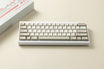
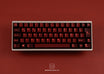
After the Tofu, Pebble and D60, the Agar is KBDfans' latest go at the HHKB layout: a 60% case made almost entirely of curves, with a crisp, clean sound.
Instead of screws or gasket strips, a silicone block mount holds the plate and PCB. The PCB connects through a magnetic pin header – no cable getting in the way when you take it apart.

01 · Design
The Agar deliberately breaks with the usual box look. Almost every edge is softly rounded and the surfaces flow into each other without a seam. The giveaway is the angled front-right corner.
Along the sides, arched cutouts make the case look slimmer from the side than it actually is.

02 · Weight
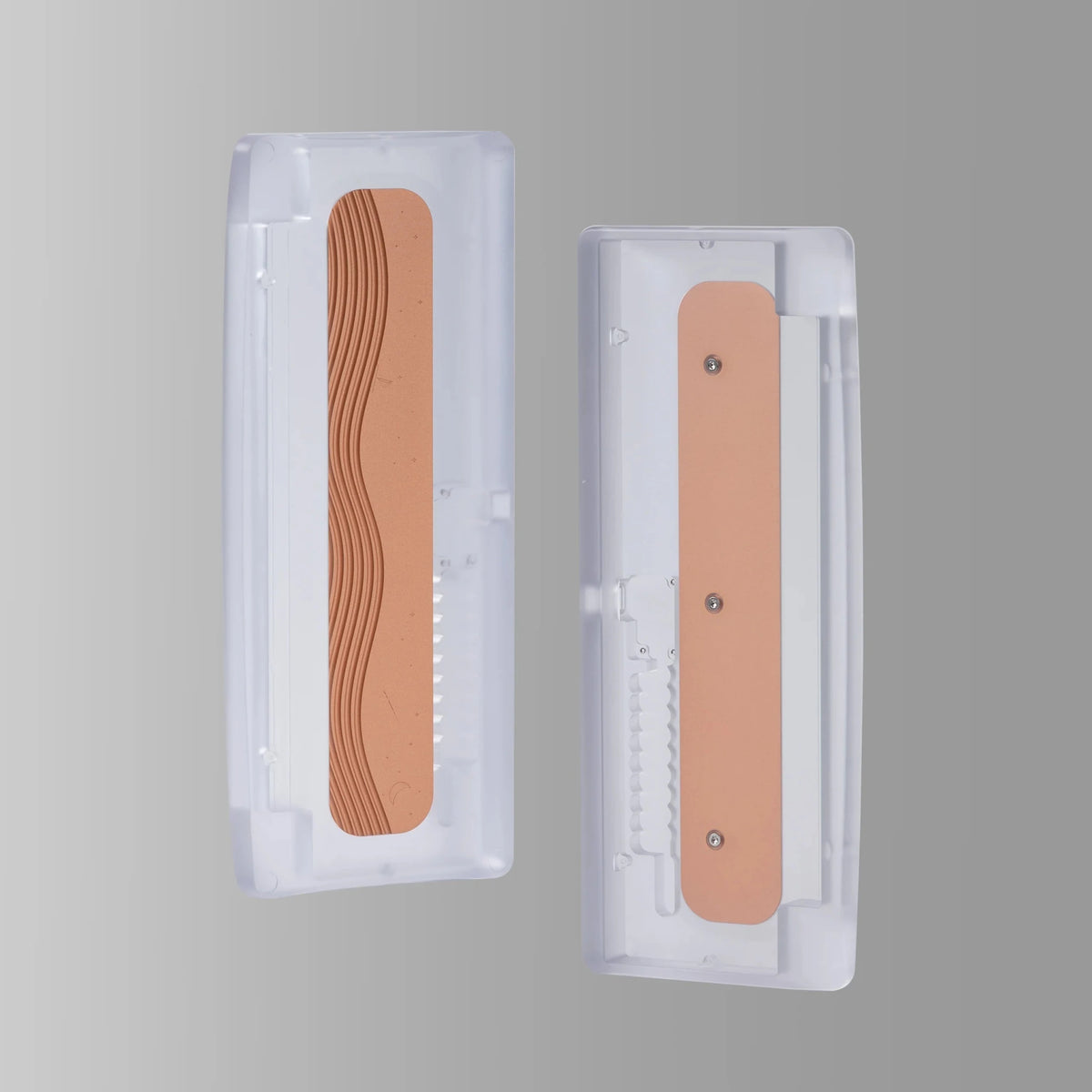
At the back of the case sits a copper weight, visible through a window in the bottom. It carries the "Starry Sea" engraving: flowing lines like waves. The copper works with the aluminium cases just as well as with the PC ones.
On PC cases the weight is not pre-installed, so the case doesn't get damaged in transit. You screw it in yourself – don't overtighten it, or the PC can crack. If you ship the board later on, take the weight out first.

03 · Mount
Plate and PCB sit in custom-moulded silicone blocks. KBDfans spent a lot of time tuning where the mounting points go and how far the blocks let things move. The result: the barebone drops in and comes out unusually easily, and there's a noticeable bit of give when you type.
A barebone hook is included for lifting it out. Keep the case foam in – without it the PCB can touch the bottom.

04 · PCB
The MX wired hot-swap PCB is 1.6 mm thick, VIA compatible and has RGB underglow and a caps lock LED. The MX dual-mode hot-swap PCB runs ZMK and connects via Bluetooth or cable; we include the matching batteries, and it has no underglow. On both MX PCBs, switches go in without soldering and come out just as easily – our guide to the hot-swap keyboard explains how it works.
The EC PCB is also 1.6 mm thick, supports Vial and has RGB underglow and a caps lock LED. It's designed for EC switches from Tecsee and Aeboards – you can add matching Naevies EC switches in the options, and two packs of 35 are enough for the Agar. Topre-compatible switches such as NIZ or Deskeys only fit with a custom plate, and your keycaps sit about 1 mm higher. According to KBDfans, PBTfans dye-sub keycaps don't fit the EC version.
The PCB links to the USB-C daughterboard through a magnetic pin header with gold-plated contacts. The magnets pull the connector into place, so there's no cable to thread when you build it.


05 · Plate
For the MX PCBs (wired and dual-mode) you choose the PC plate – it flexes a little and sounds softer – or the black aluminium plate for a stiffer, brighter feel. The EC PCB comes with the silver aluminium plate.
06 · Layout
HHKB is a 60% layout without arrow keys: a 1U key sits next to the 1.75U right shift, and the bottom row has blockers on both sides (1U / 1.5U / 7U / 1.5U / 1U). The Agar is ANSI only.
The MX wired hot-swap PCB gives you two choices: backspace as a 2U key or split into two 1U keys, and caps lock standard or stepped. On the EC PCB the backspace is split (2 × 1U).

07 · Dimensions


08 · Who is it for?
You like typing on a compact HHKB layout without arrow keys and you want a case that doesn't look like every other 60%.
You want a kit that goes together without frustration: hot-swap instead of soldering, silicone blocks instead of gasket strips, a magnetic connector instead of a cable.
More compact boards are in 60% keyboards.
such a beautiful board for a nice price
such a beautiful board for a nice price.
tbh bought it for the looks, but kind of falling in love with the layout.
Products arrived as advertised and in good condition
Products arrived as advertised and in good condition, when I needed help Monacokeys was fast and responsive
Great keyboard, good support
Got the EC version delivered two days ago. Assembly was done in less than two hours (inexperienced builder). Used the prelubed Maiz x Monacokeys stabs instead of the included Cherry stabs. The kb didn't require any calibration after assembly but setting up actuation and assigning macros was done easily in VIAL even though it was new to me. My first EC boards and I enjoy it very much this far, there is absolutely zero rattle and the feel is extremely satisfying. I usually prefer deep-sounding clacky keyboards but this is something completely different. The AEBoarss Naevies switches didn't require any additional tweaking and is silently great-sounding from the start. Only complaint is that I wanted a split backspace which isn't supported by the included plate (v2?) but still works as the keys aren't used that frequently. This board in EC version sounds much better to my ears when compared to other EC alternatives I've listened to. Only tried with KKB Skidata Neo caps (ABS) this far but doubt PBT-caps will result in any big different to the sound. The support was great even though my only question was the pre-order status as it didn't show up on the status page at first. I got a reply within the hour and the status page updated shortly after.
Great keyboard - even better customer service
Easy to build, looks gorgeous, feels nice.
I had a problem with double typing keys across the board. Monacokeys hooked me up with a new firmware that fixed the problem in no time.
KBDfans · 60% HHKB · Barebone kit
After the Tofu, Pebble and D60, the Agar is KBDfans' latest go at the HHKB layout: a 60% case made almost entirely of curves, with a crisp, clean sound.
Instead of screws or gasket strips, a silicone block mount holds the plate and PCB. The PCB connects through a magnetic pin header – no cable getting in the way when you take it apart.
01 · Design
The Agar deliberately breaks with the usual box look. Almost every edge is softly rounded and the surfaces flow into each other without a seam. The giveaway is the angled front-right corner.
Along the sides, arched cutouts make the case look slimmer from the side than it actually is.
02 · Weight
At the back of the case sits a copper weight, visible through a window in the bottom. It carries the "Starry Sea" engraving: flowing lines like waves. The copper works with the aluminium cases just as well as with the PC ones.
On PC cases the weight is not pre-installed, so the case doesn't get damaged in transit. You screw it in yourself – don't overtighten it, or the PC can crack. If you ship the board later on, take the weight out first.
03 · Mount
Plate and PCB sit in custom-moulded silicone blocks. KBDfans spent a lot of time tuning where the mounting points go and how far the blocks let things move. The result: the barebone drops in and comes out unusually easily, and there's a noticeable bit of give when you type.
A barebone hook is included for lifting it out. Keep the case foam in – without it the PCB can touch the bottom.
04 · PCB
The MX wired hot-swap PCB is 1.6 mm thick, VIA compatible and has RGB underglow and a caps lock LED. The MX dual-mode hot-swap PCB runs ZMK and connects via Bluetooth or cable; we include the matching batteries, and it has no underglow. On both MX PCBs, switches go in without soldering and come out just as easily – our guide to the hot-swap keyboard explains how it works.
The EC PCB is also 1.6 mm thick, supports Vial and has RGB underglow and a caps lock LED. It's designed for EC switches from Tecsee and Aeboards – you can add matching Naevies EC switches in the options, and two packs of 35 are enough for the Agar. Topre-compatible switches such as NIZ or Deskeys only fit with a custom plate, and your keycaps sit about 1 mm higher. According to KBDfans, PBTfans dye-sub keycaps don't fit the EC version.
The PCB links to the USB-C daughterboard through a magnetic pin header with gold-plated contacts. The magnets pull the connector into place, so there's no cable to thread when you build it.
05 · Plate
For the MX PCBs (wired and dual-mode) you choose the PC plate – it flexes a little and sounds softer – or the black aluminium plate for a stiffer, brighter feel. The EC PCB comes with the silver aluminium plate.
06 · Layout
HHKB is a 60% layout without arrow keys: a 1U key sits next to the 1.75U right shift, and the bottom row has blockers on both sides (1U / 1.5U / 7U / 1.5U / 1U). The Agar is ANSI only.
The MX wired hot-swap PCB gives you two choices: backspace as a 2U key or split into two 1U keys, and caps lock standard or stepped. On the EC PCB the backspace is split (2 × 1U).
07 · Dimensions
08 · Who is it for?
You like typing on a compact HHKB layout without arrow keys and you want a case that doesn't look like every other 60%.
You want a kit that goes together without frustration: hot-swap instead of soldering, silicone blocks instead of gasket strips, a magnetic connector instead of a cable.
More compact boards are in 60% keyboards.
such a beautiful board for a nice price
such a beautiful board for a nice price.
tbh bought it for the looks, but kind of falling in love with the layout.
Products arrived as advertised and in good condition
Products arrived as advertised and in good condition, when I needed help Monacokeys was fast and responsive
Great keyboard, good support
Got the EC version delivered two days ago. Assembly was done in less than two hours (inexperienced builder). Used the prelubed Maiz x Monacokeys stabs instead of the included Cherry stabs. The kb didn't require any calibration after assembly but setting up actuation and assigning macros was done easily in VIAL even though it was new to me. My first EC boards and I enjoy it very much this far, there is absolutely zero rattle and the feel is extremely satisfying. I usually prefer deep-sounding clacky keyboards but this is something completely different. The AEBoarss Naevies switches didn't require any additional tweaking and is silently great-sounding from the start. Only complaint is that I wanted a split backspace which isn't supported by the included plate (v2?) but still works as the keys aren't used that frequently. This board in EC version sounds much better to my ears when compared to other EC alternatives I've listened to. Only tried with KKB Skidata Neo caps (ABS) this far but doubt PBT-caps will result in any big different to the sound. The support was great even though my only question was the pre-order status as it didn't show up on the status page at first. I got a reply within the hour and the status page updated shortly after.
Great keyboard - even better customer service
Easy to build, looks gorgeous, feels nice.
I had a problem with double typing keys across the board. Monacokeys hooked me up with a new firmware that fixed the problem in no time.



 1587


 97