







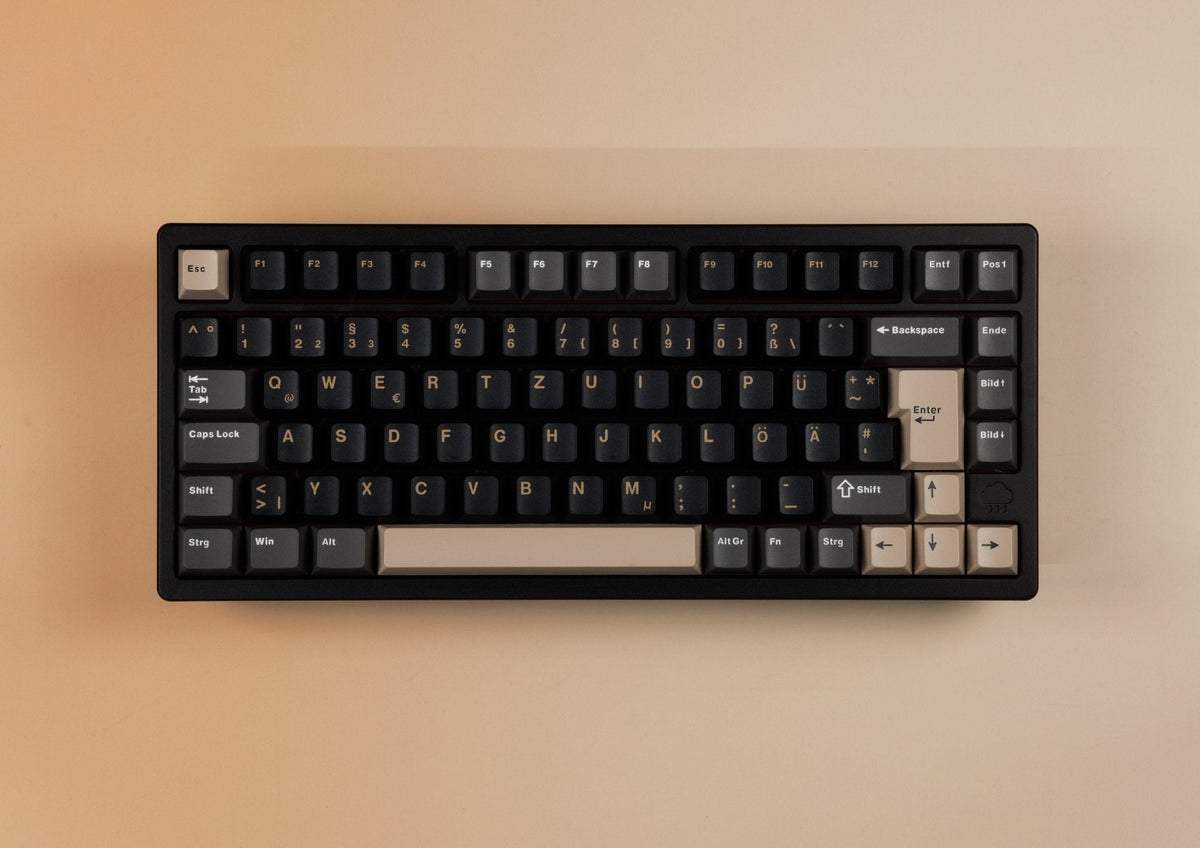
Gasket mount shows up in almost every custom keyboard description these days. But what does it mean – and does it automatically make a keyboard sound better? “Mounting” describes how the plate (the sheet the switches clip into) and the PCB are held inside the case. It decides how much the keyboard gives as you type, how even that feels and how much vibration reaches the case. For keyboard sound, though, mounting is only one piece of the puzzle: plate, PCB, dampening, switches and keycaps matter just as much. The animations below show how the mounting styles work, what plates and foam do to the sound, and what “thocky” and “clacky” really mean.
Tray, top and gasket mount: the three classics

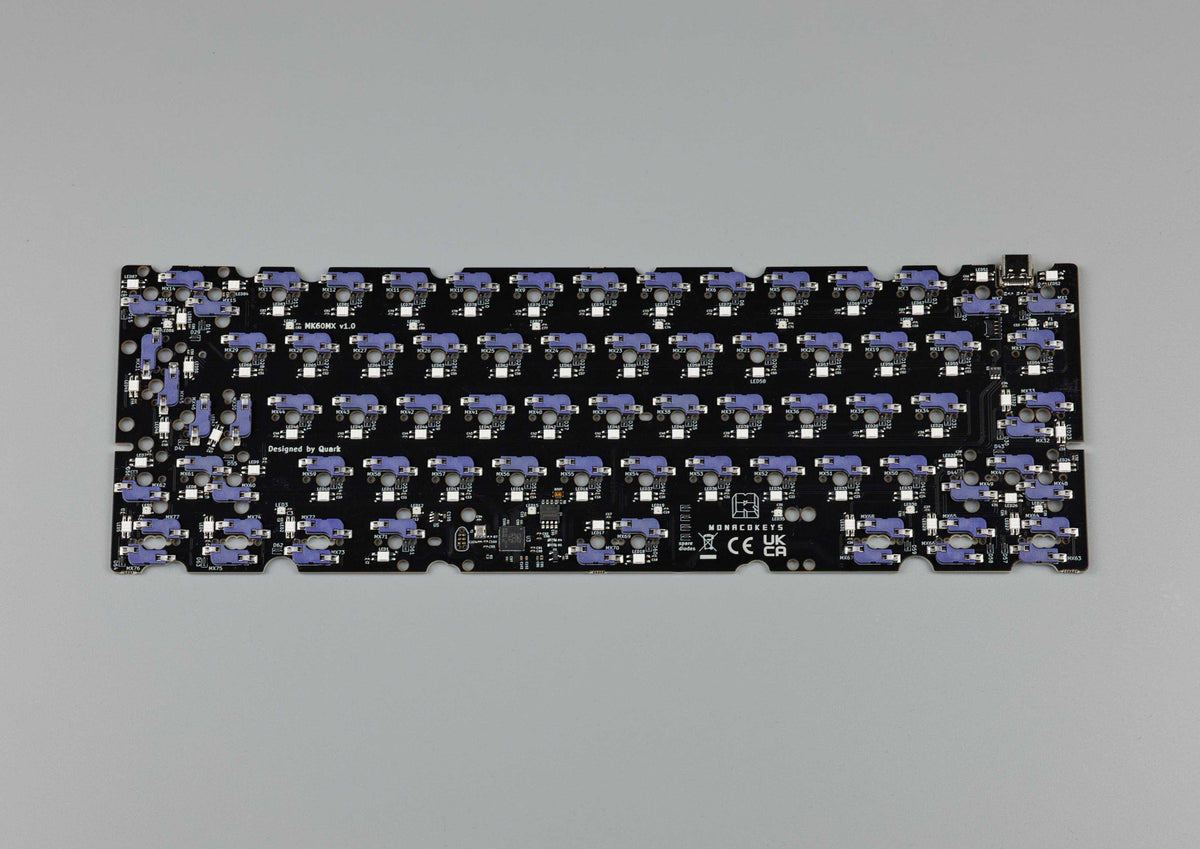
Tray mount: The PCB (and with it the plate) is screwed onto standoffs in the bottom case. It’s simple and affordable, and at 60% PCBs and cases built to the GH60 standard can often be mixed and matched. The downside: keys feel hard right at the screws and softer in between, so the feel is uneven. One example is the KBDfans Tofu60 Redux, which fits our GH60-compatible MK60MX PCB, among others.
Top mount: The plate is screwed to the top case, so the case is made of top case, plate and bottom case. The result is a firm, even feel – the classic custom keyboard feel. The sound goes straight into the top case. An isolated top mount adds silicone or Poron dampeners between the plate tabs and the case: no metal-on-metal contact, but still firm.
Gasket mount: The plate (or the PCB) rests on soft strips of silicone or Poron – the gaskets – clamped between the top and bottom case. No screws go through the plate. The keyboard usually gives noticeably as you type, bottoming out feels softer and less vibration reaches the case. How soft exactly depends on the gasket hardness, plate and PCB. Most of the keyboards in our shop are built this way.
Plate gasket or PCB gasket: With a plate gasket mount, the gaskets sit on the plate, and it often works with standard-size PCBs. With a PCB gasket mount, they sit directly on the PCB, which always requires a dedicated PCB made for that exact board. The two sound slightly different. Which one a board uses is usually the designer’s choice, based on their preferred sound and typing feel.
More mounting styles: O-ring, leaf spring, plateless and more
- Bottom and sandwich mount: the plate is screwed to the bottom case or clamped between the top and bottom case – both firm, similar to top mount.
- Leaf spring mount: The plate has spring tabs (leaf springs) that cushion the assembly – flex without gaskets, often combined with gaskets or silicone pads. The Evo80 and Evo75 use a “butterfly leaf spring” with long silicone gaskets, while the QK80 Mk2 has a leaf spring mount designed for stiffness.
- O-ring mount: A silicone O-ring wraps around the plate and PCB and holds them in the case by friction. It feels very soft and bouncy.
- PCBSnap: small silicone or FKM clips that snap directly onto the PCB. PCBSnaps are usually a drop-in replacement for the O-ring in O-ring mount boards and improve the sound and typing feel. Nuxros designs its keyboards specifically around this mount, such as the Nuxros +84. The Nexus is designed for it but can also be tray mounted. Many tray mount boards work with PCBSnaps too, even when it isn’t stated – for example the Tofu60 Redux and the Tofu60 Redux V2.
- Plateless: No plate at all – the PCB is held by gaskets or screws. The softest option with a muted sound, but it needs a soldered PCB and 5-pin switches, because hot-swap sockets rely on the plate for alignment.
Gaskets, O-rings and dampeners are rated by hardness in Shore A: the lower the number, the softer. 30A is soft and bouncy, 50A is the usual standard, and from 70A upwards it gets noticeably firmer. Replacement gaskets, O-rings and foams for many boards are available in our spare parts.
Flex: why not every gasket mount keyboard feels equally soft
“Flex” means the keyboard gives noticeably as you type. Gaskets usually provide that on their own. The keyboard gives even more when the plate and PCB move along: a soft plate (PP, PC, POM or FR4 with flex cuts) and a 1.2 mm PCB or one with flex cuts. A gasket mount keyboard with an aluminium plate and a 1.6 mm PCB without flex cuts stays firmer.

Flex cuts are long slots in the plate or PCB, for example between the rows of keys. They soften the bottom-out and deepen the sound because the assembly vibrates at a lower frequency – but only if the PCB moves along. The Rainy75, for example, combines a gasket mount with a flex-cut FR4 plate and a 1.2 mm flex-cut PCB.
Keyboard plate material: the base sound of your board
The plate shapes the base sound more than any dampening layer. The rule of thumb: dense, stiff materials like metals sound higher and feel harder when you bottom out. Soft plastics sound deeper and more muted and flex along. Thicker plates are firmer and sound higher than thinner ones made of the same material. From soft to stiff:
- PP, PC, POM: soft, muted and deep – PP flexes the most, PC (polycarbonate) lets RGB through, POM sounds “creamy”.
- FR4: the glass-fibre epoxy PCBs are made of – a balanced middle ground with moderate flex.
- Aluminium: the standard: firm, precise bottom-out, bright sound.
- Brass, copper, steel: very stiff and heavy, from full to metallic with pronounced highs.
- Carbon fibre: light and stiff with a rather bright sound – how stiff exactly depends a lot on the weave and thickness.
Our own MK60MX & GH60 plates and MK65MX & MK65MXW plates come in PP, aluminium and FR4. You’ll find more in our keyboard plates collection. Keep in mind: on top and gasket mount boards, plates are usually cut for one specific case. They’re mainly interchangeable on standardised tray mount boards (GH60).
Dampening: keyboard foam, switch pads and force break
Keyboard sound comes from the switch (bottom-out and return), keycap, plate, PCB and the hollow space in the case. Dampening changes which parts of that you still hear. Many prebuilt keyboards ship with several layers of foam.

- Case foam: sits in the bottom case under the PCB, for example made of Poron, EVA, silicone or cork. It fills the hollow space and absorbs resonance and reverb – the fix for a “hollow” sound.
- Plate foam: sits between the PCB and plate, with cutouts for the switches. It dampens vibrations between the two and takes off some of the highs.
- Switch pad (PE foam, IXPE): a very thin sheet directly between the bottom of the switches and the PCB. It reflects sound upwards, making it “poppy” with a creamier bottom-out. On hot-swap boards it should only be about 0.5 mm thick so the pins still sit securely in the sockets.
- Force break pads: thin pads or tape where the top and bottom case touch. They break the metal-on-metal contact and help against “case ping”, the metallic ringing of the case.
Foam makes a board quieter and deeper, but also more uniform – which is why some manufacturers deliberately go for a sound chamber without foam, like the Neo65 Core Plus, whose optimised sound chamber sounds good without foam. Foam is still included so you can tune the board to your taste. And foam doesn’t replace stabilizer tuning or lubing: rattling stabilizers and spring ping from the switches stay audible. Lube is the fix for spring ping – find out more in our guide on how to lube switches.
Two warnings: white PE packaging foam can build up static and damage the PCB – use a proper IXPE switch pad instead. And we don’t recommend the tape mod (painter’s tape on the back of the PCB): it makes the sound a little poppier, but components and chips on the PCB can overheat underneath and get damaged. A few years ago it was a popular way to tune budget keyboards. Today almost every keyboard is tuned for sound from the factory, so the tape mod isn’t needed any more.
Thocky vs clacky: what makes a thocky keyboard?
The community has its own words for keyboard sound:
- Clacky: bright, lots of highs – typical of dense, stiff materials.
- Thocky: deep and full – typical of soft materials and plenty of dampening.
- Hollow: the resonance of an empty case.
- Pingy: metallic ringing from the case or springs.
These are descriptions, not measurements – two people don’t always mean the same by “thock”. For a thocky keyboard, go for a softer plate (PP, PC, POM), case foam and maybe an IXPE switch pad. For a brighter, clackier sound, stiff plates like aluminium or brass with less dampening fit better. Switches and keycaps play their part in the sound as well.
Keyboard mounting styles compared
| Mounting | How it’s attached | Typing feel | Worth knowing |
|---|---|---|---|
| Tray mount | PCB on standoffs in the bottom case | firm at the screws, softer in between | simple, affordable, often GH60-compatible at 60% |
| Top mount | plate screwed to the top case | firm and even | sound goes straight into the top case |
| Gasket mount | plate (or PCB) on silicone or Poron strips | softer, gives noticeably | less vibration in the case |
| Leaf spring | spring tabs in the plate | flex without gaskets | often combined with gaskets |
| O-ring | silicone ring around plate and PCB | very soft and bouncy | O-ring hardness sets the feel |
| PCBSnap | silicone or FKM clips on the PCB | soft, decoupled | drop-in replacement for O-rings, often fits tray mount cases too |
| Plateless | no plate, PCB only | softest | muted sound, soldered PCB only |
Which mounting style is right for me?
Gasket mount isn’t a mark of quality, it’s a design choice. Firm and direct or soft and forgiving – that’s down to taste.
- You like a firm, precise bottom-out: top mount, ideally with an aluminium plate.
- You want noticeable flex and a deep sound: gasket, O-ring or leaf spring with a soft plate and a flexible PCB – for example the Evo80 with a PP plate, flex-cut PCB and multi-layer foam from the factory.
- You can’t decide: some kits include two systems, such as the Neo75 and Neo98 (gasket and top mount) or the Typface Kafka (gasket or O-ring).
- You like to build and swap parts: a tray mount case to the GH60 standard with the PCB and plate of your choice.
You’ll find all cases under keyboard cases and individual parts under components.
FAQ: gasket mount and keyboard sound
Is gasket mount better than top mount?
Not better, just different. Gasket mount is softer and decoupled from the case, top mount is firmer and more direct. How a keyboard ends up feeling depends on the combination of mounting, plate material and PCB.
My gasket mount keyboard barely flexes – is it faulty?
Probably not. With an aluminium plate and a 1.6 mm PCB without flex cuts, a gasket mount only gives a little. A softer plate (PP, PC) or softer gaskets with a lower Shore A rating change that.
Can I change the mounting style later?
Only if your kit includes both systems or the matching spare part is available. On top and gasket mount boards, the plate and PCB have to fit the case exactly. O-ring and many tray mount boards can often be switched to PCBSnaps.
How do I make my keyboard more thocky?
A softer plate, case foam and possibly an IXPE switch pad – as long as matching parts exist for your board. Lots of foam also makes the sound more uniform, though.



 1557

 97